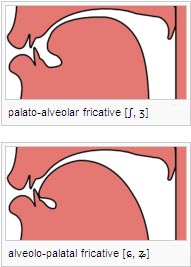
The palato-alveolar ejective fricative is a type of consonantal sound, used in some spoken languages. The symbol in the International Phonetic Alphabet that represents this sound is ⟨ʃʼ⟩.
Features
Features of the palato-alveolar ejective fricative:
- Its manner of articulation is fricative, which means it is produced by constricting air flow through a narrow channel at the place of articulation, causing turbulence.
- Its place of articulation is alveolar, which means it is articulated with either the tip or the blade of the tongue at the alveolar ridge, termed respectively apical and laminal.
- Its phonation is voiceless, which means it is produced without vibrations of the vocal cords.
- It is an oral consonant, which means air is allowed to escape through the mouth only.
- It is a central consonant, which means it is produced by directing the airstream along the center of the tongue, rather than to the sides.
- The airstream mechanism is ejective (glottalic egressive), which means the air is forced out by pumping the glottis upward.
Occurrence
See also
- Index of phonetics articles
References
External links
- List of languages with [ʃʼ] on PHOIBLE